
Home |
Submissions |
Subscriptions & Permissions
Editorial Board |
The London Journal Trust |
Prizes |
Blog
The London Journal Blog
In these posts, our authors explore topics related to their published articles, including methodological or theoretical issues, matters of contemporary relevance, and questions raised by their research that need further investigation. We hope that reading these short pieces will enhance your understanding of the linked published articles and encourage new research on London.
Index of Posts:
A City Written in Diaries
By-Elections in London History
To Cut or Not to Cut? Sunday Trading, Then and Now
Bringing Water Back to the Tower of London’s Moat
Revisiting 1920s London Through a Chinese Lens
With Due Acknowledgement: From Bermondsey’s Tanneries to The London Journal
Fugitive Material: The Case of the Nineteenth-Century Playbill
Smithfield is Dead, Long Live Smithfield
A City Written in Diaries
By Angelina Andreeva | Posted 10 November 2026
Digital historical maps have transformed the ways that anyone can explore the history of London, allowing us to peel back the layers of the modern city and discover the streets, buildings, and landscapes of its past. But what if we could go a step further? What if, alongside mapping the physical city, we could map the experiences of the people who moved through it, encountered its spaces, and invested places with personal, social, or emotional significance centuries ago? This question, sparked by my interest in fascinating projects such as Layers of London, eventually led me to ask whether it was possible to bring together the scattered references to places, journeys, and everyday encounters preserved in early modern diaries and use them to explore London from the perspective of the people who inhabited it. What might we discover if, instead of reading these accounts primarily as narratives of individual lives, we also examined them as records of how people moved through and experienced the city? My research explored this question through the diaries of Samuel Pepys, John Evelyn, and Robert Hooke, three men of different backgrounds whose lives intersected with many of the same institutions, streets, and social environments of Restoration London.
Diaries are familiar sources for historians. They can reveal personal relationships, political opinions, religious beliefs, and responses to major historical events. But if we are lucky enough, they also contain another kind of evidence: references to the places people visited, the routes they followed, the means of transport they used, and the encounters that took place along the way. The diarists that I examined, for example, consistently highlight the importance of recording precise locations in relation to their daily experiences. Significantly, it was not only the encounters of obvious importance that demanded such spatial precision, but also minor incidents that they mentioned almost in passing: the coffeehouse where Robert Hooke’s friend took a fall and broke his nose, the route that Samuel Pepys followed in search of his family’s dog, or the house into whose window John Evelyn happened to peer only to discover a woodcarver whose work he admired enough to introduce him to Charles II. Such moments repeatedly proved to me that locations were recorded with as much care as the events themselves, suggesting that place was integral to how experience was understood and remembered.
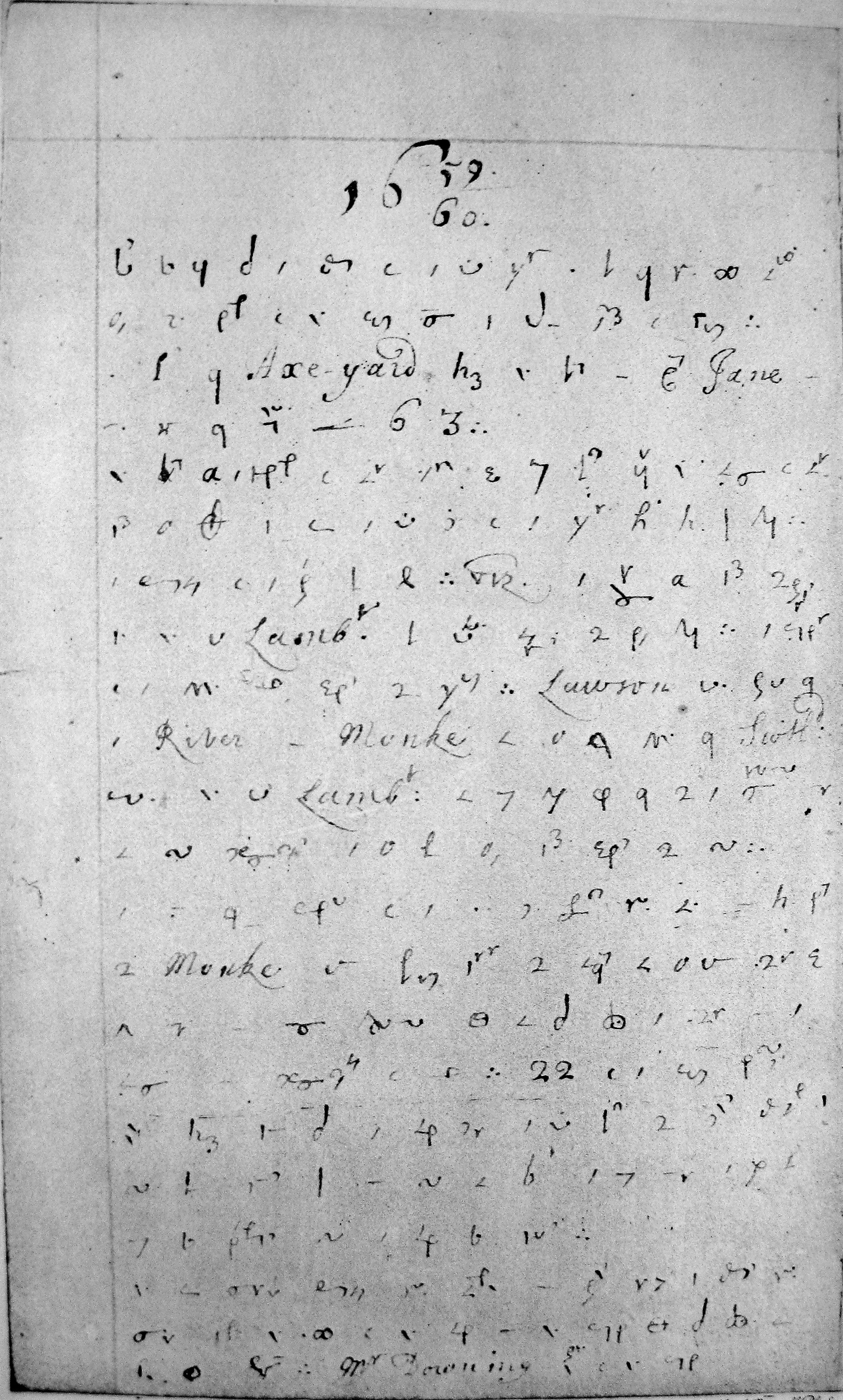
A page from Samuel Pepys’s diary.
The Diary of Samuel Pepys: Pepysiana, ed. H. B. Wheatley (London, 1899). Wikimedia Commons.
I wanted to find out what these spatial details could reveal when considered together. Where did these men spend their time? Which places repeatedly brought them into contact with other people? How did their movements reflect their ambitions, occupations, and social relationships? And how did their engagement with London change over the course of several decades? To investigate these questions, I combined close reading of the diaries with systematic data collection and Geographic Information Systems (GIS) to map the recorded lives of these men throughout the years.
One of the most revealing findings of my research was that movement through London was about much more than getting from one place to another. In seventeenth-century London, walking, travelling by water, and using a coach offered different practical advantages, but they also carried social meanings. The means by which someone travelled could communicate wealth, status, independence, connections to patrons, and sometimes none of these. Journeys were often social occasions in themselves, providing opportunities to maintain friendships, negotiate relationships, and demonstrate one’s place within the urban community. The diaries, however, reveal how differently these choices could be understood. Pepys, whose career and social ambitions developed considerably during the period covered by his diary, was particularly conscious of how he appeared to others. His changing use of transport, from walking and hiring hackney coaches to acquiring his own horses and private coach, reflected his changing circumstances. Yet he continued to walk extensively, balancing convenience and expense against the importance he sometimes attached to public appearance. Evelyn, by contrast, moved through London as a gentleman and courtier for whom private carriage was an obvious necessity. Hooke, whose work as a scientist and surveyor required him to move frequently between professional commitments, often prioritised practicality and efficiency. Seen in this way, movement through London becomes a key mechanism for understanding how social position was negotiated in practice rather than simply expressed.
Mapping the diaries also encouraged me to reconsider the significance of familiar London landmarks. Places such as Westminster Hall and the Royal Exchange, for example, had recognisable political and commercial functions, but their importance in everyday life extended far beyond them. The Royal Exchange was a centre of commerce, but it was also a meeting place where news, political intelligence, business, and personal reputation intersected. Pepys’s diary reveals that his engagement with the Exchange formed part of his wider efforts to establish himself within London’s news networks. Being present in the right place could matter almost as much as possessing the right information, as knowledge circulated through relationships, and those relationships were sustained through repeated encounters in particular urban spaces.
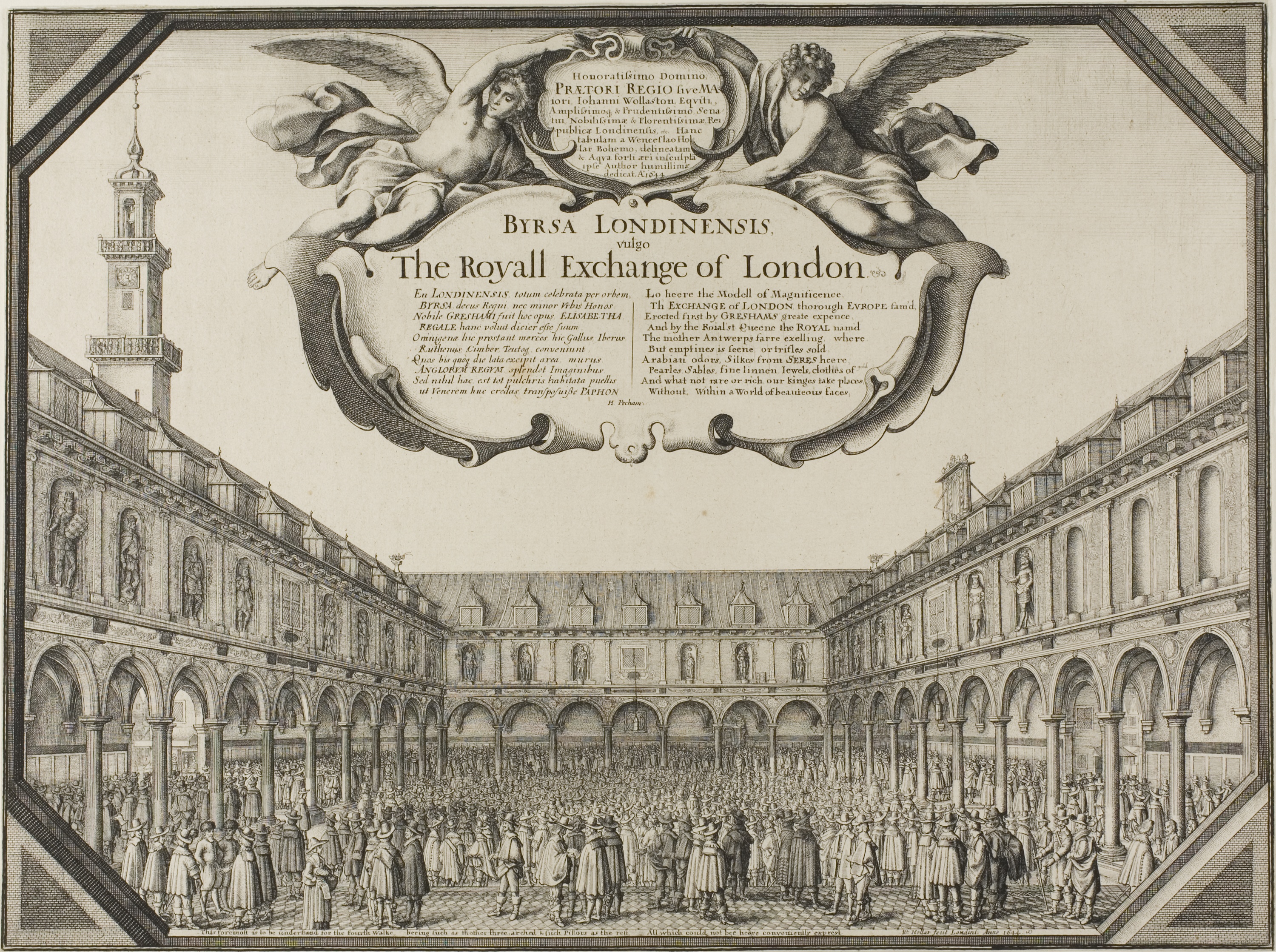
The Royal Exchange in London, as built by Thomas Gresham.
Wenceslaus Hollar, The Royal Exchange of London (1644). Clarence Buckingham Collection, Art Institute Chicago.
The same principle emerged elsewhere. Churches could serve as places of worship and devotion, but also as settings for sociability and the public negotiation of status. Coffeehouses accommodated business meetings and information exchange, although their importance as centres of public discourse varied between individuals. Domestic, commercial, political, and recreational experiences were not neatly separated into distinct spheres but frequently overlapped within the same places and journeys. These findings suggested that understanding London’s history required attention not only to the institutions that organised urban life, but also to the everyday practices through which people made use of them.
The importance of these practices became particularly apparent when I examined the consequences of the Great Fire of 1666. Although the Fire forms the subject of my article, it also represents one part of a much broader investigation into the relationship between people and urban space. Working with the diaries helped me reconstruct their authors’ spatial and social routines, day-by-day and year-by-year. Yet the destruction of streets, buildings, and familiar landmarks in 1666 disrupted these established routines in just four days. Mapping movements before and after the Fire helped me investigate how these disruptions affected the ways my diarists engaged with London. While Evelyn articulated a vision of renewed London, inspired by the prospects of rebuilding and improvements, Hooke was directly involved in surveying and redesigning the city alongside Christopher Wren, translating destruction into plans for restoration. Hooke’s diary thus became a record of rebuilding practice, documenting how engagement with urban space continued in the period of reconstruction. At the same time, Pepys encountered the changing city in his daily movements, capturing both his challenges and evolving meanings of navigating the new, emerging London.
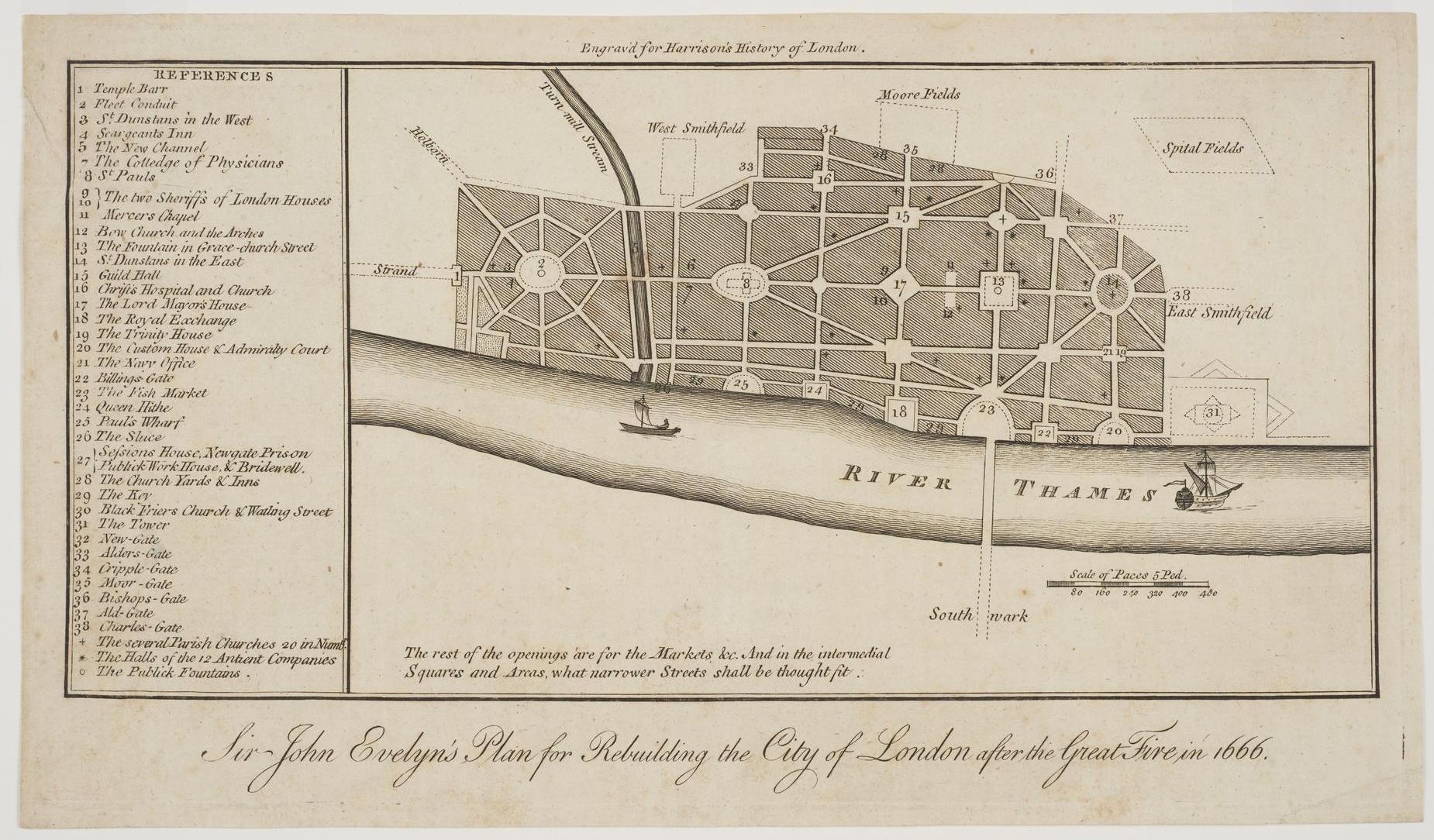
John Evelyn’s plan for rebuilding the City of London after the Great Fire in 1666. © London Museum.
Significantly, these accounts reveal that recovery involved more than the reconstruction of physical structures. Familiar routes carried habits, memories, and social connections that could not simply be restored alongside the buildings. As the city changed, so too did the patterns through which people encountered it. The Fire, therefore, brought into focus something that had emerged throughout my research: the relationship between a city and its inhabitants is continually produced through everyday experience and shaped by personal ambitions and anxieties, external circumstances, and the physical layout of the urban environment.
Working with Pepys, Evelyn, and Hooke convinced me of the value of approaching personal diaries as sources for spatial history. They cannot represent the experiences of every Londoner, yet when read comparatively and examined across time, they can reveal patterns that extend beyond the lives of the individuals who recorded them. The most rewarding aspect of this research was discovering how much could be learned from details that initially seemed ordinary: a journey across the Thames, a visit to a park, or a repeated appearance at the same meeting place. Considered together, such details help reconstruct a city as it was encountered in everyday life, rather than only as it was described in official records or represented in plans for its development. Ultimately, mapping the historical diaries is not simply about recovering where people went. It is about understanding what those places meant, what happened in them, and how the everyday movements of individuals helped make London the city it was.
By-Elections in London History
By Pippa Catterall and Jason Frost | Posted 2 November 2026
Ask a prime minister about a by-election defeat and you will usually get a shrug. ‘It’s mid-term, it’s a protest,’ as David Cameron put it in 2013. Ask the media and you get the opposite reaction entirely: over 9,000 articles were published about the 2021 Hartlepool contest alone. Somewhere between the ministerial dismissal and the media circus lies a more interesting truth, and it is one that scholarship has been slow to pursue. By-elections have too often been treated as little more than thermometers for government popularity, when in reality they are events in their own right; moments when a single locality becomes the focus of national attention and when local and national grievances are aired together for once in primetime.
This political theatre is nothing new. Dickens satirised it in The Pickwick Papers, drawing on his own reporting from campaigns in the early 1830s, while Trollope in Can You Forgive Her (1865) described contests featuring armies of men carrying placards and public houses open on every corner. Churchill claimed that the chorus girls of Daly’s Theatre sat up all night addressing envelopes for his 1924 Westminster Abbey campaign. Children were still being taught election rhymes to sing for or against candidates into the 1920s, and today’s fringe candidates are their direct descendants; less absurd than they appear and often a rather useful measure of disaffection from mainstream politics.
What has changed is the machinery. Before 1832, by-elections were the principal route into the Commons and were mostly uncontested, not least because of the expense. The range of occasions for by-elections has declined since then. By-elections due to ministerial appointments, bankruptcy, or insanity have essentially disappeared. What remains is elevation to the Lords, and—more usually—death, resignation, or scandal. The Recall of MPs Act 2015 added a further route, and in doing so revived the very old idea that an MP answers first to their constituents rather than to their party or the executive. That instinct runs deep, and it shows in the data. Government vote share fell by an average of 12% in by-elections between 1979 and 2022, but that average conceals enormous local and circumstantial variation, and only 39.5% of seats that changed hands reverted to their usual allegiance at the following general election. Local candidates do best. Local issues matter.
The consequences are real rather than symbolic. By-elections have changed government policy, settled arguments about the direction of parties (as in the Conservative contests in Westminster in 1924 and 1931), and acquired near-mythic status in national debate, as East Fulham did in 1933 during the arguments over appeasement and rearmament. They have also ended premierships. Margaret Thatcher later reflected that the restiveness of Tory backbenchers was transformed into open panic by the Eastbourne by-election of October 1990, with further defeats weeks later helping to seal her fate. Andy Burnham’s win in Makerfield in June 2026 brought Keir Starmer’s premiership to an end.
Nowhere is this impact clearer than in London. It is not simply that contests in the capital are more readily noticed within the Westminster bubble, though they are. London is itself a variegated political entity with shifting loyalties and a complex political geography, and the neat division between a Conservative Outer London and a Labour Inner London, popularised by the electoral map of the 2008 mayoral contest, has never quite held. Nonetheless, these imagined geographies persist in the imaginations of both the public and historians. As Jerry White observed, ‘Bexley is a world away from Brent.’
Meanwhile, the capital’s by-elections have repeatedly functioned as early warning systems on policy issues. The Liberal defeat in Bow and Bromley in 1899 signalled public support for the South African War. Croydon in 1909 was a key moment in the Dreadnought naval race and the constitutional crisis around the People’s Budget. Camberwell North in 1922 led the Lloyd George Coalition to drop some of the more unpalatable aspects of the Geddes Axe. Hammersmith in 1926 showed the electoral impact of the General Strike, while Richmond Park in 2016 became a proxy for the national argument over Brexit.
London by-elections have also been laboratories for electioneering experimentation. Mitcham in 1923 saw Labour pioneer the mass canvass. Brent East in 2003 saw the Liberal Democrats make innovative use of computer technology. As this suggests, London has also been a proving ground for new electoral tactics. Digital micro-targeting, like mass leafleting before it, was rehearsed in London constituencies before going national.
Defining London for these purposes means treating it as a broad urban, cultural, and geographical space rather than applying the strict administrative boundaries of the time. This is why Romford in 1894, then still in Essex, and Bexley in 1946, then only just becoming a suburb, belong squarely in the story.
The wider point is that, despite rich literatures spanning electoral studies, urban history, political sociology, and media studies, no study has systematically examined London’s by-elections as a distinct analytical category over an extended timeframe. Most either absorb them into general electoral trends or fixate on the sensational features of isolated high-profile contests, rarely offering insight into voter perceptions or local conditions. In this special issue, nine contests spanning 1861 to 2003, from Marylebone and the City of London through to Brent East, are used to make a straightforward case: by-elections are best understood not as episodic noise between general elections but as recurrent expressions of the politics of place.
To Cut or Not to Cut? Sunday Trading, Then and Now
By Justin Kirkland | Posted 26 October 2026
My article on London’s Barbers’ and the development of Sunday labour regulations in the fifteenth century brought to mind my experience as an American conducting research in England. After getting to Peterborough late one Sunday evening, I frantically searched for an open store where I could buy a charging cord for my phone, having left mine on the train. As my phone’s battery dwindled to 10%, I found Asda fifteen minutes before it closed at 5pm and quickly bought a charging cord. Walking down Peterborough’s darkened streets on the way back to my Airbnb while clutching my new charger, I pondered how different this was from the USA. Walmart, in my hometown of Lubbock, Texas, was open 24 hours a day, seven days a week. For the first time, I had encountered the modern legacy of England’s Sunday trading restrictions.
Thomas Arundel’s 1413 letter requesting that the London Common Council enact a civic ordinance banning barbers from working on Sundays, along with the subsequent law, has been frequently cited by historians for the past century and a half as an example of what Sylvia Thrupp called ‘spasmodic Sabbatarian legislation’. Yet it was not until I began digging into other sources that a different picture emerged. While flipping through J. A. Twemlow’s Calendar of Entries in the Papal Registers Relating to Great Britain and Ireland in my university library one afternoon, I happened across two entries relating to London’s Barbers’. That fortuitous find convinced me that behind these sources there was an untold story of jurisdiction, industrial regulation, and competition within a medieval trade.
In some respects, the story feels surprisingly modern. The Barbers’ attempts to secure Sunday restrictions through ecclesiastical authorities bear a resemblance to contemporary efforts by industries to establish regulatory frameworks for themselves. For example, leading Artificial Intelligence companies have called for governmental regulation and third-party monitoring. Both the Barbers’ and the AI companies seek to set standards for their industries and enforce some sort of idea regarding fairness. Yet, their true intentions remain difficult to pin down. Are they driven by idealism or more selfish concerns? Perhaps both? Or are they driven by external pressure? The attempts by the Barbers’ provide an example of how one industry in fifteenth-century London sought to establish and enforce an industry standard.
Competitive fairness was undoubtedly one issue pushing the Barbers’ in the fifteenth century to seek regulation. Such an issue was not unique to the times. In a 1930 debate in the House of Lords over the Hairdressers’ and Barbers’ Shops (Sunday Closing) Bill, Herbrand Sackville, 9th Earl De La Warr, argued in favour of the bill, declaring that though the tradesmen had originally sought to voluntarily agree to close on Sunday, such agreements continually broke down: ‘If one hairdresser in a district opens on Sunday, all the other hairdressers in that district are compelled to follow his example.’ Notably, the bill itself was promoted by the hairdressers themselves.
Following similar reasoning as Earl De La Warr, Microsoft’s president Brad Smith recently stated to the BBC that ‘the challenge for any self-regulatory regime is if it’s left to the industry alone, frankly, the good companies will do what you want. It’s the companies that are not as responsible that you need to worry about.’ The same probably could have described the situation among London’s barbers in the fifteenth century. Successful and powerful barbers probably willingly abstained from work on Sundays. Their reputation might suffer if they did not abstain from labour on Sundays as canon law demanded—and good Christians were supposed to do. After all, it was the wardens and guardians of the guild that appealed to the pope, undoubtedly acting in accord with the wishes of the guild’s powerful members. They targeted those recalcitrant barbers who apparently refused to close shop on Sundays, many inhabiting sanctuaries within London—areas that had a seedy reputation and defiance of authority. To the guild leadership, these barbers represented an obstacle to the uniform standards they hoped to impose on the trade. Self-regulation apparently did not work for London’s fifteenth-century barbers and, in the opinion of some AI industry leaders, does not work now.
Whether AI companies will be any more successful than London’s fifteenth-century barbers remains to be seen. The petitions submitted to the pope allege that barbers in St Martin le Grand and Westminster hid behind jurisdictional boundaries—since they were sanctuaries—rather than conform. The same could conceivably happen today with AI companies. In a global community, the opportunity to hide behind favourable national jurisdictions is a natural move. Even those barbers within the jurisdiction of the liberty of London often violated the regulations. The historian Sydney Young, in his masterful history The Annals of the Barber-Surgeons of London, Compiled from their Records and Other Sources, conceded on the basis of records from later centuries that ‘No trade, perhaps, has from the earliest days, down to our own times, owned such persistent breakers of the Fourth Commandment [i.e., Third Commandment] as have the barbers. Our records abound with by-laws, enacted and renewed over and over again on this subject, and details of the delinquencies of numerous barbers in this respect, and of their punishments by fine and imprisonment crop up everywhere’ (48). At least in later centuries, papal bulls and civic ordinances did not halt barbers from working on Sundays.
The parallels between fifteenth-century barbers and modern AI companies reveal enduring questions about power, regulation, and the limits of industry-led governance. The Barbers’ guild reached the conclusion that they needed the intervention of external authorities to enforce an industry regulation. Many modern AI companies have reached similar conclusions. This says a great deal about the limits of industrial organisations and the necessity of resorting to political power.
Bringing Water Back to the Tower of London’s Moat
By Caroline Wilhelmsson | Posted 3 September 2026
In my recent article about the Royal Engineers and their impact on the architecture of the Tower of London in the nineteenth century, I discussed how they gave the moat its current appearance. But before that, the first moat at the Tower was constructed by William the Conqueror as a defensive ditch to protect the White Tower. As the castle expanded, so did the moat, which gained its current configuration during the reigns of Henry III and Edward I, in the thirteenth century.
The moat was not just a defensive feature. During the medieval period, it served as a fishing pond and provided a valuable source of food for the fortress’s occupants. It also allowed for transportation and linked directly with the river via Traitors’ Gate. This allowed goods and people to be moved around the wharf and the Tower more efficiently. It also gave royals and courtiers a more discrete way in, as they could come by barge and disembark at the sally port bridge next to Byward Tower, thus entirely bypassing the city.
The moat’s original design relied on tidal drainage and gravity to fill and empty naturally. And yet, this simple system presented constant problems throughout the centuries. The stagnant waters spread diseases and made the garrison sick, while a pungent smell permeated Tower Hill. Accumulating silt made drainage difficult and threatened to turn what should have been an efficient water barrier into a shallow and unhealthy marsh.
It is unclear why the Tower’s moat was so problematic, when other fortresses did not experience such difficulties. It might have been badly constructed to start with, though this seems unlikely, as foreign experts were specifically brought over from Flanders to dig the moat. It is more likely that subsequent alterations made to its design, especially the building of the current wharf in the fourteenth century, disrupted waterflow.
There were several major attempts to clean the moat and remove the accumulating silt to improve both sanitation and navigability, but none were ever totally satisfactory. In the nineteenth century, the Royal Engineers were tasked with finding a solution. Only two alternatives became clear: either completely reconfigure the water channels or drain the moat altogether. The Duke of Wellington, in his capacity as Constable of the Tower, eventually ordered it drained, and by 1844 the ditch was dry.
The dry moat has been used for various purposes since then. It was enjoyed for recreation by the garrison, as an outdoor exercise area, and as a parade ground for drills. During the First World War, horses that were requisitioned throughout London were kept there before being sent to Southampton, where they embarked for France. The Territorial Force (volunteers who made up the bulk of the first waves of recruitment during the First World War) also camped in the moat while awaiting further deployment. During the Second World War, part of the moat was used as allotments while a barrage balloon was stationed in the western section. Later in the twentieth century, it was converted into a garden for the Tower’s population and even had a football pitch and tennis court.
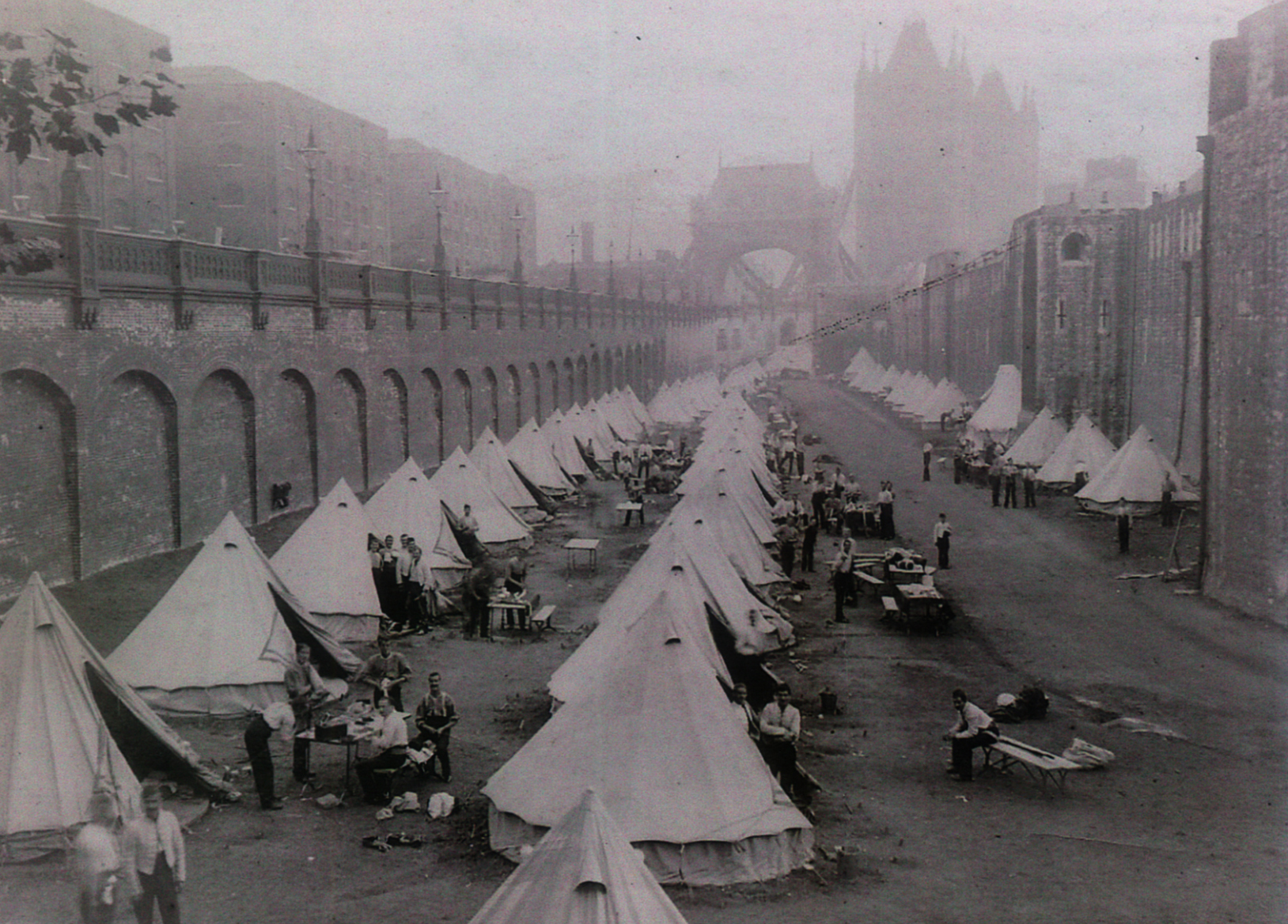
Encampment in the moat to accommodate extra troops, presumably brought in for Queen Victoria’s Diamond Jubilee in 1897. © Historic Royal Palaces.
Yet, none of these schemes involved water, and except for the catastrophic flood of January 1928, it has been dry ever since. Today, Historic Royal Palaces are working on (purposefully) bringing water back to the moat for the first time in 180 years. Over the next couple of years, the project (which has now received planning permission) will see the moat transformed into a new biodiverse area. There will be sustainably fed pools and rills, vegetation and flowers specially chosen to promote the local wildlife, and new landscaping that will support this new environment while limiting the impact on the moat’s archaeology.
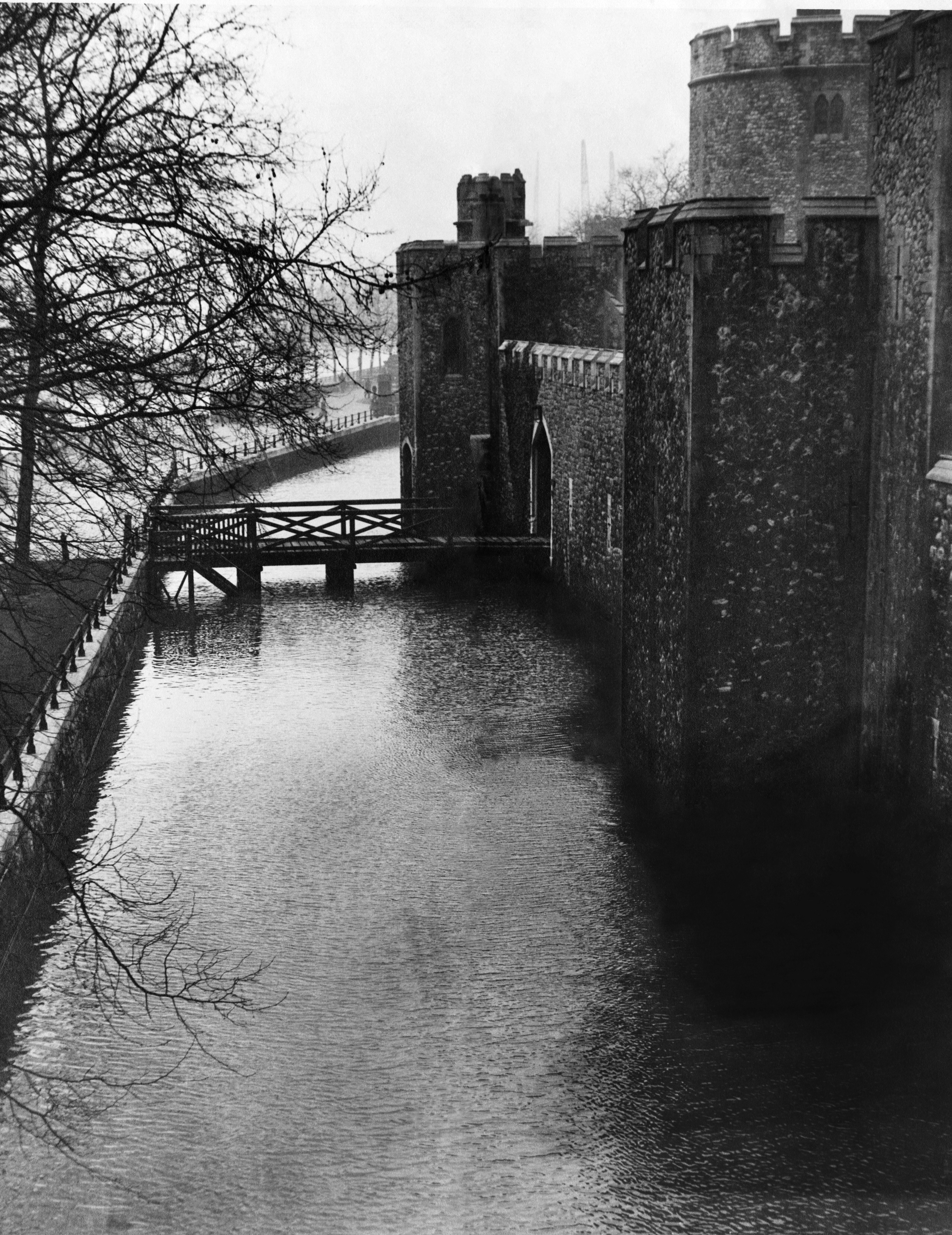
The moat flooded in January 1928 when the Thames broke its banks. © Historic Royal Palaces.
It is not the first time that attempts have been made to turn the moat into a more pleasant space fit for today’s needs and priorities, however. Back in 2022, Superbloom saw the moat rewilded and temporarily turned into a meadow to celebrate Elizabeth II’s Platinum Jubilee. The massive display of constantly evolving flowers was complemented with sculptures and a playful slide to provide access directly from the Tower Hill. The popularity of this project showcased the moat’s potential for becoming a thriving natural asset in the heart of the City. Building on that success, the new landscape will be a nod to the moat’s historic appearance. It will echo what was initially constructed for military defence, while transforming it into a new green which will be open to Tower visitors. Unlike Superbloom, this evolution of the moat will be permanent.
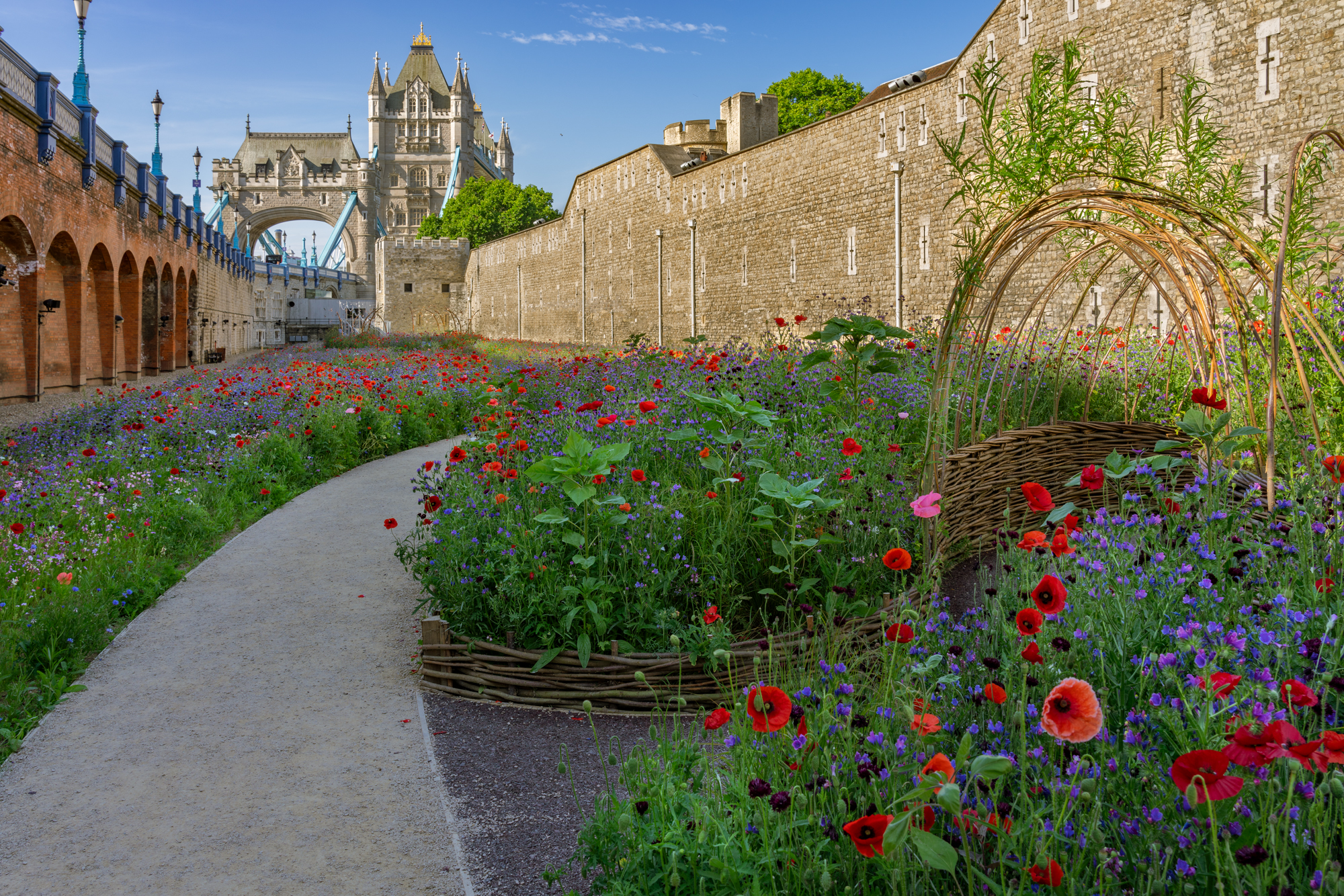
Superbloom, by Andy Butler, 2022. © Historic Royal Palaces.
The project’s long-term ambition brings with it new challenges in terms of environmental impact and sustainability. Historic Royal Palaces’s priority is to ensure that the new naturalistic landscape does not affect the moat’s archaeology, that it is capable of lasting with minimal further intervention, and that it does not divert resources away from priority areas—which is particularly relevant considering recent climatic challenges. New systems will be put in place to collect and recycle rainwater that will then be used for irrigation. That includes using the water that still collects in the underground brick culverts constructed by the Royal Engineers back in the 1840s. The new wetland will also help improve the Tower’s defensibility against flash-flooding. A team of experts consisting of archaeologists, historic buildings curators, horticultors, and gardeners are working to achieve the best possible outcomes in this respect.
The new moat landscape will allow visitors to escape the Tower’s hullabaloo and step into a green and peaceful oasis in the heart of one of London’s busiest neighbourhoods. Interpretation will feature illustrated graphics and characters from the Tower’s past, integrated into the landscape using traditional materials such as stone, metal, and timber. Complementing the visitor route, it will tell the story of the moat and ensure that it is a learning experience in itself.
The City and Tower Hamlets are two of the least green boroughs in London per capita. This is not only detrimental to people’s wellbeing but also limits biodiversity. Tower Hamlets residents are already able to visit the Tower for £1, and the moat will be included in this offer. The new wetland landscape will be visible to the public and accessible upon purchase of an entry ticket. It is also hoped that the new moat will attract birds, insects, and other local creatures in search of a greener home. What was a dry ditch for over 180 years will soon be teeming with life and will provide a stunning new setting for this World Heritage Site while paying homage to its history.
Revisiting 1920s London Through a Chinese Lens
By Calvin Goh | Posted 21 July 2026
My article in The London Journal was inspired by ‘The Blind Banker’, the second episode of BBC’s Sherlock, which takes place in London’s Chinatown and features Chinese characters. My original intent was to discuss how the London space is reconfigured through the lens of detective fiction, but the depiction of the Chinese people in the episode struck me as problematic: they functioned primarily as plot devices, and their representations leaned into the stereotypes of the foreign Other that somehow continues to be perpetuated well into the twenty-first century. In one of the scenes, the presence of the Chinese smuggling ring in London is explained by their cover as circus performers, which blatantly exoticises and sensationalises Chinese tradition and culture.

Gemma Chan as Soo Lin Yao in ‘The Blind Banker’ (2010). Image courtesy of the BBC.
This realisation led me on a different path, and my search for other media representations of the Chinese community in London introduced me to Thomas Burke’s Limehouse Nights (1916). Understandably, these representations are derived from a British point of view, and hence I sought material that offered an alternative voice to the plight of the Chinese population—preferably one that did not colour the Chinese people as crooks and criminals. It was therefore a pleasant surprise to chance across John Shen Yen Nee and S. J. Rozan’s ‘Dee and Lao’ detective series, which is set in 1920s London and features a generous cast of Chinese characters. The novels are situated in the genre of detective fiction, and Dee and Lao were specifically modelled after Holmes and Watson. I must profess that before reading the first novel, titled The Murder of Mr Ma (2024), I did not know what to expect, but the embedded intermedial and intertextual references were more than enough to pique my interest. While the novel itself borders on the fantastic, it contends quite well with critiquing earlier representations of race and gives a voice to those who hitherto did not have one. To further sweeten the deal, the two primary characters, Judge Dee (as the Sherlock Holmes figure) and Lao She (as the John Watson figure), are based on actual, historical persons—the former was an actual Chinese magistrate who lived during the seventh century, and the latter, a Chinese author who lived during the twentieth century.
In an interview, the authors stated that their first novel was meant to serve as a prequel to Lao She’s Mr Ma and Son (1929). This ‘revelation’ becomes significant as it revises how one engages with Lao’s novel, which is based on his lived experience in London between 1924 and 1929. While Lao expresses a clear resentment of the xenophobic treatment endured by the Chinese community, the Chinese characters in his novel are unable to overcome the racial prejudices that oppress them. However, the fictional Lao’s account of the events in The Murder of Mr Ma captures not the filtered, mediated perspective of the narrator in Mr Ma and Son, but a (revised) version of historical events through the eyes of a historical figure, which destabilises existing social structures that would otherwise be taken for granted.
While The Murder of Mr Ma is certainly not an authentic representation of history (nor does it claim to be), it does to some extent redress pejorative views of the Chinese community in London by de-centring the Western ethnocentric lens and drawing attention to the under-represented aspects or viewpoints that are largely ignored and undocumented. Contemporary literary fiction thus proves a versatile medium for such discourse, as it generates a fertile space in which history can be reimagined and perspectives can be reframed. All of this goes to show how history and literature are neither static nor confined to time and space; they can be revived, over and over again, in ways that prompt reconsiderations of sociocultural dynamics in the past and the present.
With Due Acknowledgement: From Bermondsey’s Tanneries to The London Journal
By Ian Stone | Posted 15 June 2026
The acknowledgements of an academic article are a funny thing. They are probably passed over by most readers, whereas they might be the first—and indeed only—part of the article to attract the attention of others eagerly seeking evidence that their contribution to the published endeavour has been rightfully recognised. As a historian, I have always enjoyed reading the acknowledgements because they tell a story, albeit truncated, of how history came to be written. I thought I would expand upon the acknowledgements in my recent article on Leathersellers’ College in Bermondsey to set out the fuller story of how this article went from genesis to publication.
Several years ago, I was approached by some people connected to the leather industry in this country who asked me if I’d be willing to write a history of their industry. I was pleased to say yes. Leather manufacturing and use was probably the third-largest industry in premodern Britain, after food and textiles, and it remained significant after the industrial revolution. The order to bring the leather trade under government control was signed on 2 September 1939—the day before Britain went to war with Nazi Germany—which tells us just how important leather manufacturing was to the war effort.
As someone born and bred in south-east London, I was also aware of how significant Bermondsey had been as a centre for leather manufacturing and trading. Indeed, in the middle of the nineteenth century, it is quite likely that Bermondsey’s tanners were responsible for one-third of all leather production in Britain. Writing a history of the leather industry also afforded me an opportunity to write a history of places like Bermondsey.
In the 1890s, then, when the Worshipful Company of Leathersellers was looking to support technical education in leather manufacturing, Bermondsey was the obvious place to begin. At that time, many of London’s livery companies had decided to focus their philanthropic efforts on education in the trades with which they had historically been associated. It was their response to reformers who had questioned their very existence, and perhaps the most famous and enduring example of the companies’ efforts was the establishment of the City and Guilds of London Institute in 1878. The Leathersellers’ were involved in the creation of the City and Guilds from the start, but they also wanted to do more for the leather trade, particularly, and in my article, you can discover how they did that, eventually establishing their own Leathersellers’ College on Tower Bridge Road in 1909. For most of the twentieth century, this was one of three centres for leather education in Britain—the others were in Leeds and Northampton—and I quickly decided that I would have to write a chapter (that is, about 12,000 words) on the history of these three sites in my book.
The Leathersellers’ have a very good collection of records from their college, including minutes from meetings of the Company’s education committee and the committees that administered the College, as well as accounts, registers, photographs, prospectuses, and even transcripts of evidence provided to an inquiry into the College in 1927. Historians have had these records in their hands before. Penny Hunting, for example, made use of them for her history of the Company, which was published in 1994, but no one has ever used them for a focused study of the College’s history.
In 2023, as I began to wade through the Company’s records, I very soon realised that there was enough material there to write 12,000 words on the history of Leathersellers’ College in Bermondsey alone. There would not be room for that in the book, however, so the obvious answer was to write an article instead.
My research at Leathersellers’ Hall revealed that the Company had at first supported education in Bermondsey in conjunction with the Borough Polytechnic Institute, which subsequently became London South Bank University, and with the British and Foreign Schools’ Society, whose records are now at Brunel University, so I then spent time in the archives at those two institutions. In 1951, Leathersellers’ College became a National College, that is, a monotechnic college supported by the Ministry of Education, so there was plenty for me to get stuck into at The National Archives in Kew, too.
It was in 2024 that the article really began to take shape. First, I was invited by Professor Michael Mainelli, the 695th Lord Mayor of London in 2023/24, to give a lecture in March for his Knowledge Miles series. This was an online lecture series that celebrated the City of London’s role as the world’s coffeehouse for discussion and debate and the contribution to human knowledge therefrom. The Leathersellers’ College was the obvious topic for my lecture, and any academic will tell you that lectures and seminars like this really do provide the opportunity to start crystallising one’s thoughts.
Second, I spent most of that summer at Leathersellers’ Hall; this time, however, not with the Company’s records. When I had first started my research for the book, I visited the Museum of Leathercraft, which was housed above the Grosvenor Centre in Northampton. I remember well how Graham Lampard, the Curator of the Museum, opened a door to show me a room filled with ledgers, folders, books, and other material. ‘What’s all this?’ I asked, and he told me that it was the archive of Leather UK, the trade association for the leather industry in Britain. These records went back to the 1880s, and they had never, to the best of my knowledge, been used by any historian before. ‘You’ll probably want to read it all, won’t you?’ asked Graham. I puffed out my cheeks and nodded while silently calculating the months that it would take to get through it all and wondering how on earth that would be possible. I could neither commute up to Northampton daily nor live there for that amount of time. In the end, I didn’t have to. The Leathersellers’ Company and the fund that was established to pay for the book arranged and paid for the records to be brought down to London in some sixty storage crates for me to study there.
These records also needed a proper home, and the Modern Records Centre at the University of Warwick agreed to take them all. Thus, as I was busy reading the material, Kate Higgins, the archivist at Leathersellers’ Hall, and Rebecca Darnill, a project cataloguer, were hard at work archiving the catalogue according to the Modern Records Centre’s system.
Third, I teach a history of London course to students from Dartmouth College in New Hampshire who come to London for a semester. As part of their assessment, they must put together a walk that explores the history of a small part of London. In autumn 2024, I suggested to the group of students, who had east London as their area, that vocational education might make for a good theme. There is, after all, plenty to bring out there, from the former Cordwainers’ College in Bethnal Green, through the East London Technical College on Mile End Road, to the Building Crafts College in Stratford—all of which have enjoyed the support of various livery companies. Perhaps rather more selfishly, it was a subject that was very much in my thoughts at the time, and the students were interested enough in the topic, or at least kind enough to humour me. Regardless, they put together a fantastic walk, and their work certainly brought my thoughts into further focus.
In early 2025, then, some two years after I first started my research, I was ready to write the article. I sent drafts of it to friends and colleagues for their advice—Graham Taylor, a local historian in Bermondsey, and Professor Paul Muselwhite at Dartmouth College, for example. I submitted the first draft to The London Journal in March, and the peer reviewers quickly set about my work, suggesting I situate my study better in the history of vocational education nationally and say a little less about the livery companies and Bermondsey. I should have seen that coming. The people who asked questions after my lecture for the Knowledge Miles series, which was convened by Mark Huxley, were much more interested in the history of vocational education in Britain than they were anything else.
Even after this, it took the best part of a year to go through the revision process and to get the article edited and ready for publication. Indeed, we might even compare the total time it took to write this article with that required to make a piece of leather in preindustrial Britain. Two or three years for the beast to grow and then, after slaughter, the ‘year and a day’ that its hide would have spent in the tanning pits.
It was, however, all well worth it. It really is true that everyone who read the article, or who asked questions after that lecture, or who contributed to the editing, helped to make the final, published version a much better and more balanced piece. As the acknowledgements conclude, I am grateful to them all.
Fugitive Material: The Case of the Nineteenth-Century Playbill
By Stephen Ridgwell | Posted 1 June 2026
In my article on the pantomimes of Nelson Lee (1806–1872), much was made of the period’s playbills. Held in numerous collections around the country and in varying states of preservation, archivally speaking they are ‘fugitive material’: jobbing ephemera chronicling a theatre’s present and coming attractions but with little thought to historical use. Produced every week in their thousands, these inky promises of a good night out spoke of the moment when theatregoing in London had its greatest appeal. It’s no coincidence that when Charles Dickens wrote on the ‘Amusements of the People’, his primary focus was Lambeth’s Old Vic. Always an actor at heart, Dickens had multiple links to Victorian drama, and from the windy hyperboles of Vincent Crummles to Mrs Blimber’s improvised hair curlers, his writing is full of playbills. As he told his friend and biographer, John Forster, the avid playgoing of his youth, ‘studying the bills first, and going to where there was the best acting’, was crucial to his literary formation.
One of Dickens’s favourite haunts was the Adelphi Theatre on the Strand. Along with the Surrey Theatre, Astley’s, and the English Opera House (Lyceum), it’s clearly registered in John Orlando Parry’s London Street Scene (1836). Spurred on by advancing print technology and a growingly literate public, the dawning of a commercially primed information age is unerringly captured by Parry. If the past is represented by the dome of St Paul’s, the present (and future) is the bill-sticker’s restless collage of things to buy, do, and see. And the closer one looks, the more one finds theatres virtually present in their playbills.
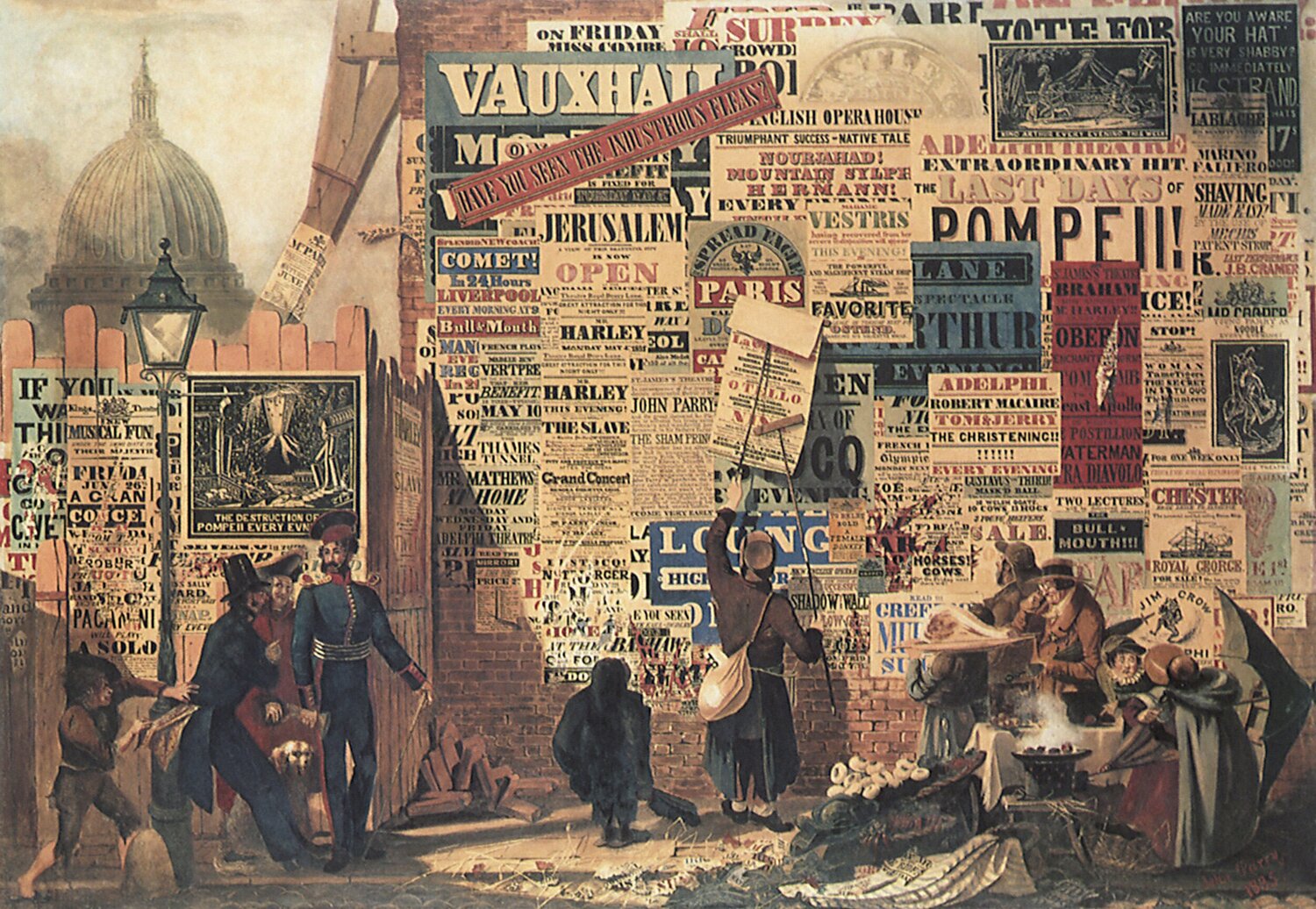
A playbill sticker at work. John Orlando Parry, London Street Scene (1836). Wikimedia Commons.
As a leading venue in the emerging West End, the Adelphi features heavily in this scene. Most obviously, we have its version of Edward Bulwer-Lytton’s 1834 novel, The Last Days of Pompeii, and below it, a revival of Tom and Jerry. Taken from Pierce Egan’s bestselling Life in London, it was one of the Adelphi’s biggest hits of the 1820s. Here it is paired with The Christening, the first ever staging of a story by Boz, though done (not for the last time) without Dickens’s permission. Now look at the children to the right of the brazier and the bill immediately above them. Following a successful run at the Surrey, in November the Adelphi presented T. D. Rice’s Jim Crow, a blackface act imported from the States that quickly spawned a host of imitators. Indeed, so popular was ‘Daddy’ Rice that he also appeared in the 1836 pantomime Harlequin Jim Crow and the Magic Mustard-Pot. Rice was last at the Adelphi in 1843, the year in which the Theatre Regulation Act put all the capital’s theatres under the control of the Lord Chamberlain—a move that had important implications for playbills.
When researching the pantomimes of Nelson Lee—which included at least six for the Adelphi—I was necessarily drawn to his work for the City of London Theatre in Bishopsgate. Having first written for the City the year after its opening in 1837, between 1848 and 1868 he was co-owner and manager. At this point it passed to Great Eastern Railways and was demolished in 1871. Though like most of its East End rivals, the City’s career was checkered; at its 1850s peak, it was one of the best minor theatres in London. Accompanied by five (not quite) randomly selected bills, I now propose a brief tour through the City’s own dramatic history.
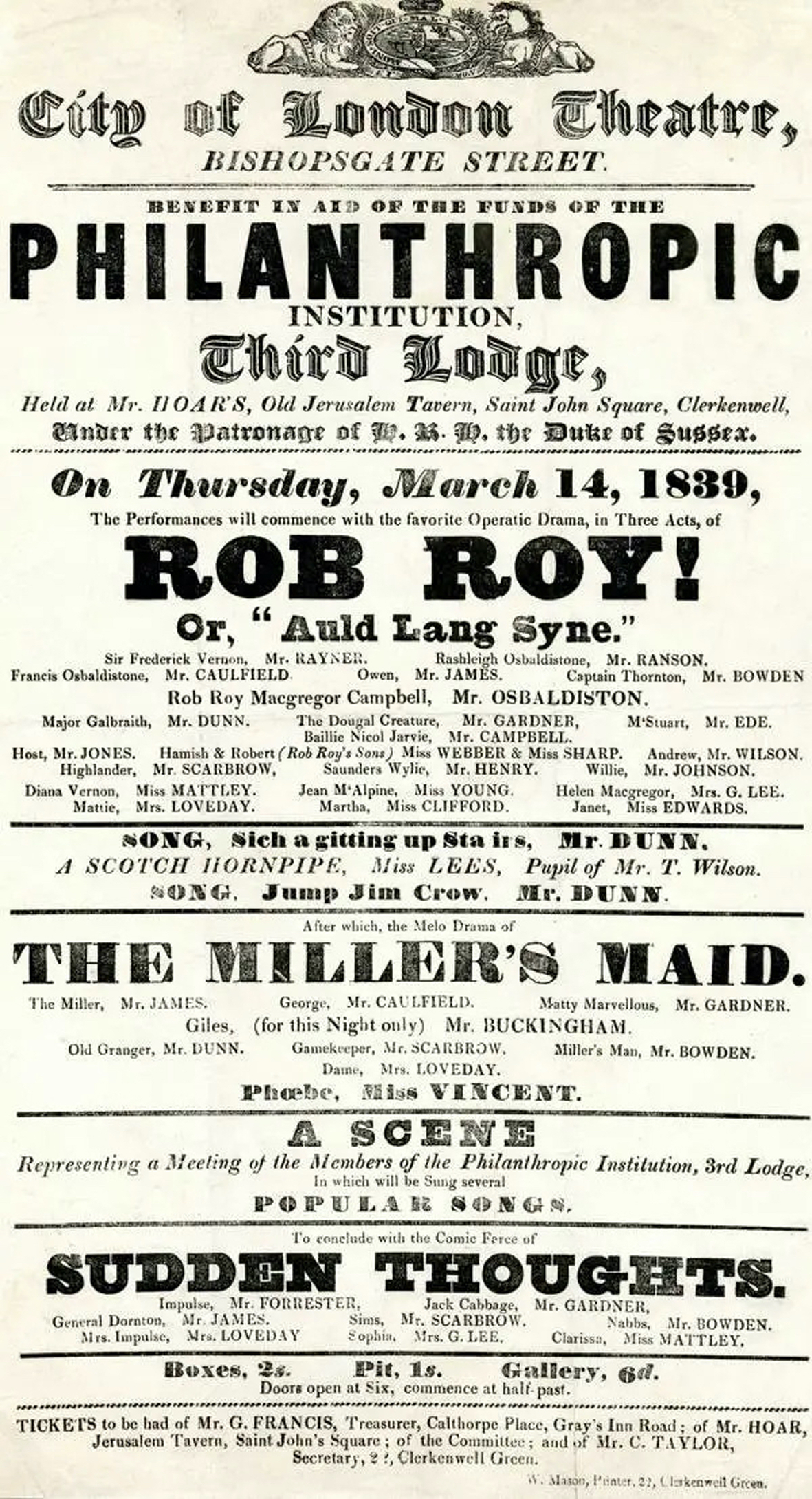
City of London playbill for Rob Roy (1839). Courtesy of Bishopsgate Institute.
Produced by W. Mason of Clerkenwell Green, this 1839 bill has much to tell. Starting from the top, it reveals an important subsidiary role for neighbourhood establishments like the City via the regular hosting of charity nights. Second, we learn of the continued popularity of Sir Walter Scott. The great historical novelist had died in 1832, but his work continued to be profitably mined for the stage. Playing Rob Roy was the City’s charismatic actor-manager, David Osbaldiston, while as The Miller’s Maid we find Eliza Vincent, a 23-year-old veteran of melodrama and also Osbaldiston’s partner. Testament to the unusual opportunities afforded by her profession, Vincent was one of several City women to combine acting duties with management. She was co-running the Vic when Dickens visited in 1850. Finally, we might observe the ongoing presence of Jim Crow—here played by John Dunn, a former lawyer’s clerk who had recently impressed as Newman Noggs in the City’s unsanctioned version of Nicholas Nickleby.
Moving to 1845, the City is now in the hands of the rakish journalist and serial speculator, Frederick Fox Cooper. Having failed to woo his audience with martially themed spectacles such as Wellington, Nelson and Napoleon, he has resorted to the Newgate-style drama of Oliver Twist. Notable here is the amount of text being carried by the bill. Printed by S. G. Fairbrother of Bow Street, it carefully delineates the novel’s twisting plot while offering neat descriptions of its main characters. Fagin was thus ‘A Jew, a Keeper of a Fence or Den for thieves’, while the Dodger, played by the well-known monkey impersonator George Wieland, is ‘a young gentleman ... most readily disposed to appropriate the movables of others’.
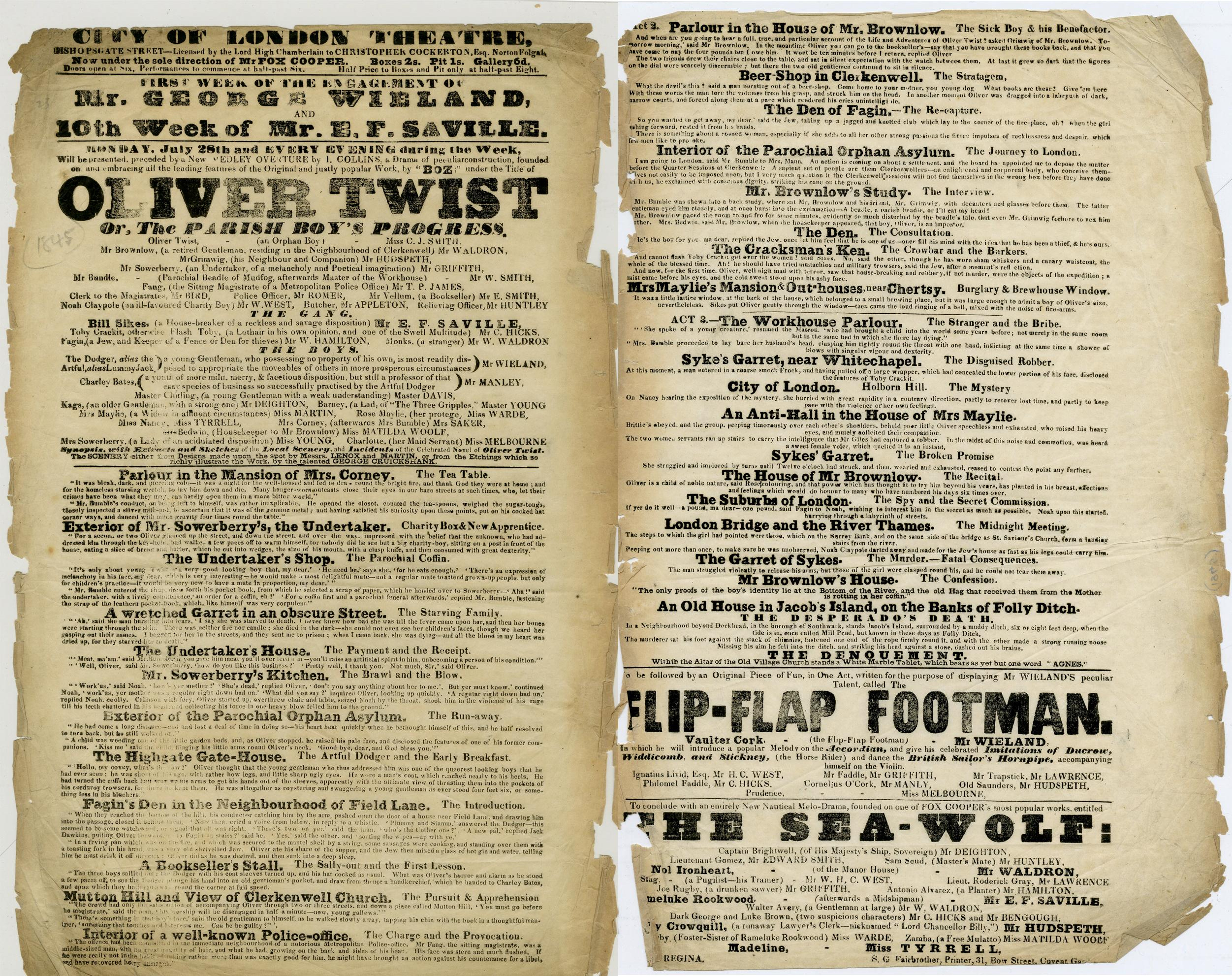
City of London Playbill for Oliver Twist (1845). Courtesy of Special Collections, University of Kent.
Starring E. F. Saville as a coolly brutal Bill Sikes—he would openly taunt the audience during his protracted killing of Nancy—the piece alternated with the equally disreputable Jack Sheppard. Not only was the City sailing close to the wind with these officially frowned-upon dramas, but it was also now charged with being a disorderly house. Losing money, and under the watch of the police, Fox Cooper’s days were numbered. But if this marked a low point for the City’s fortunes, salvation was at hand. First in the form of the eminently respectable Robert and Maria Honner, their Cricket on the Hearth (1846) was a far cry from Oliver Twist, and then in the shape of Nelson Lee and his shadowy business partner, John Johnson.
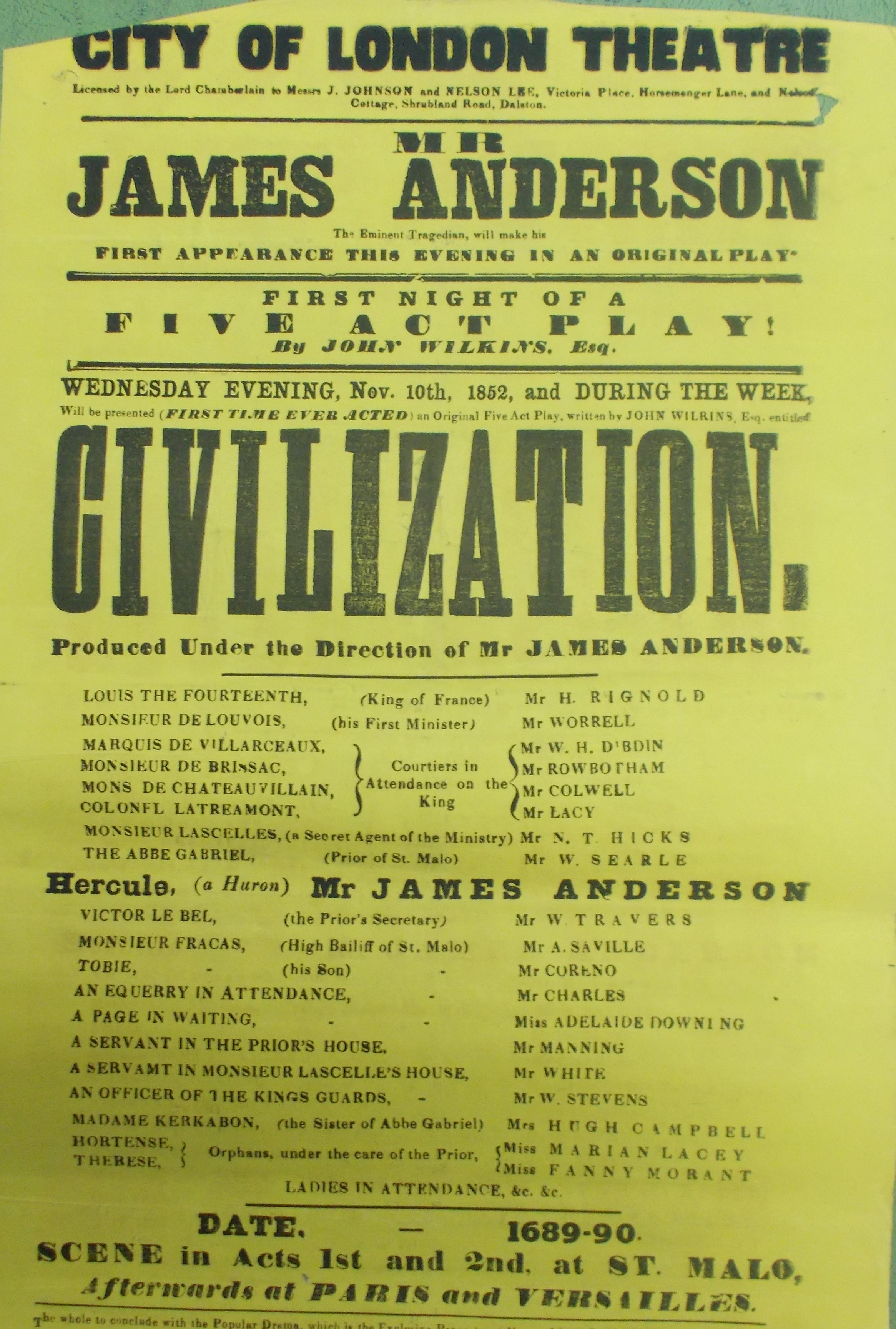
City of London playbill for Civilization (1852). © The National Archives
Similarly the work of Fairbrothers, the bill for Civilization (1852) is markedly different from Oliver Twist. Typifying the fugitive nature of playbills, I found it in the bottom of a storage box at the National Archives. Under the terms of the 1843 Act, theatres were obliged to send their bills to the Lord Chamberlain, most of which were then destroyed. However, thanks to an administrative oversight, the City’s entire run for the year has survived: an unexpected bonus for the hopeful searcher in archives. Though employing the regulation slab serif Egyptian typeface, this bill for Civilization has a strikingly classical look. This not only supports its five-act length, but also its elevated source in Voltaire’s eighteenth-century novella L’Ingenu. Written by the City’s talented in-house dramatist, John Wilkins, and starring the renowned classical actor James Anderson, this production typified the City’s cultural aspirations in the wake of the Great Exhibition. Earlier in the year it staged the West End smash, The Corsican Brothers (Queen Victoria saw the original five times), and also presented The Winter’s Tale. In this it became the first theatre of its kind to offer ‘this mighty creation of the Poet’s brain’. Meanwhile, topical subjects were covered with the Australian Gold Rush drama The Emigrant’s Progress, while Lee’s seasonal extravaganza, King Emerald! Or, Harlequin’s Crystal Palace on Fairyland boasted of being the City’s first ever ‘Thousand Guinea Pantomime’.
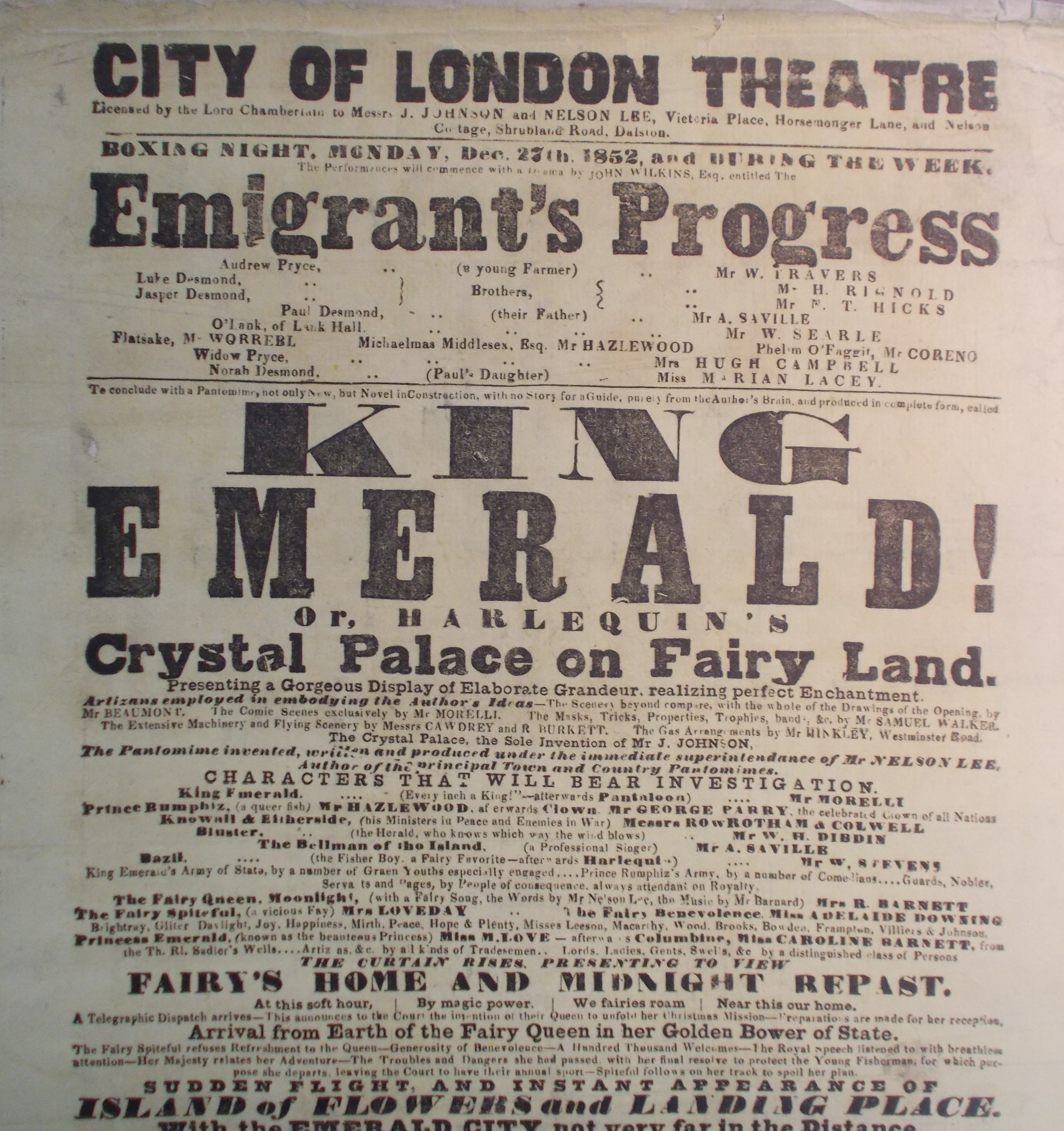
City of London playbill for The Emigrant’s Progress and King Emerald (1852). © National Archives
Faced with growing local competition, and the looming threat of music halls, the City held its own for the rest of the decade. But with the 1860s proving more challenging, by the time its site was bought for railway development, things were clearly on the slide. For its remaining three years, the City’s new owners leased it to a series of less-than-committed short-term managements. Along with continued developments in printing, this fact is clearly revealed in our final bill.
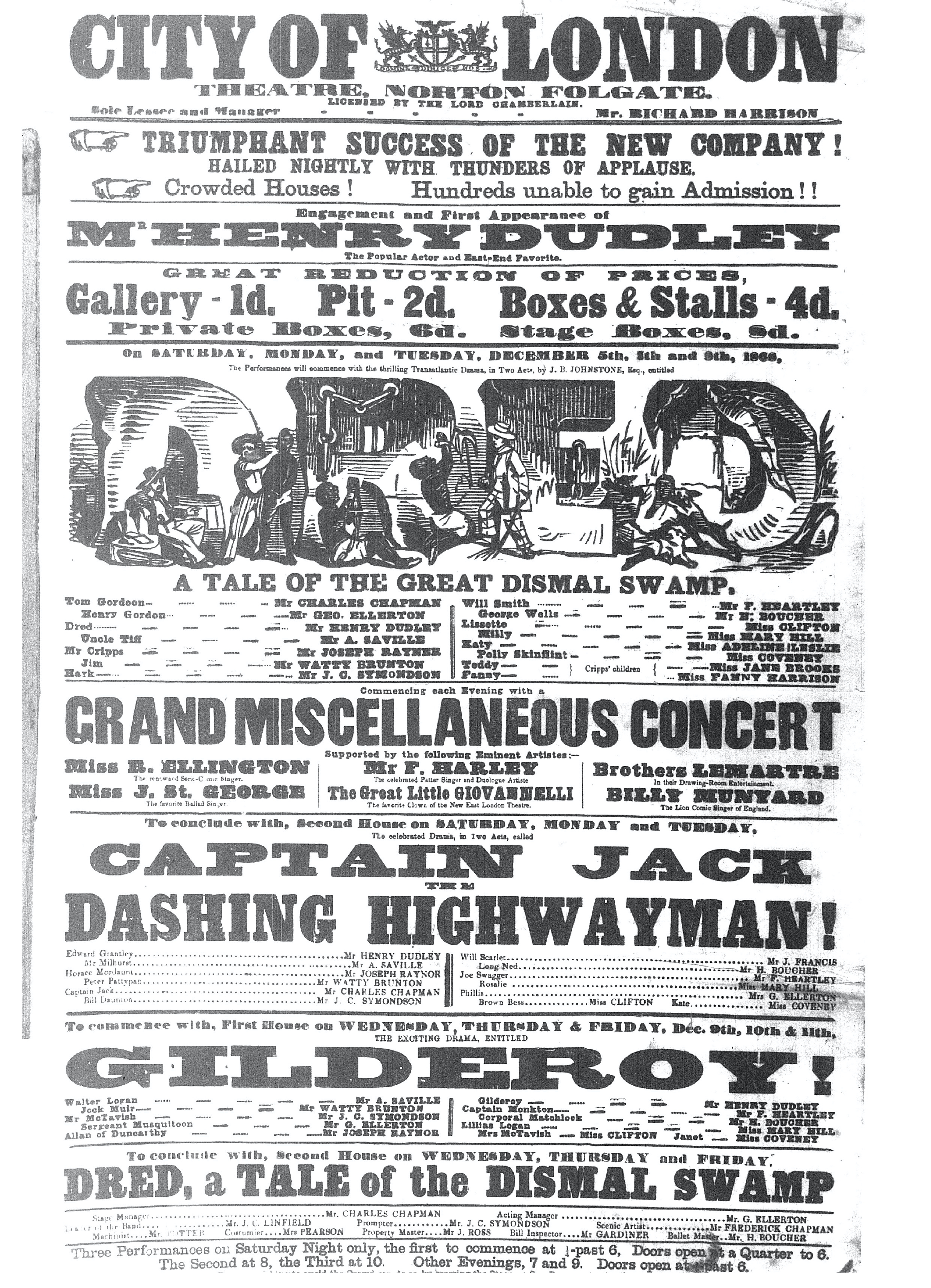
City of London playbill for Dred (1868). © British Library Board.
Once unusual in playbills (look again at Parry’s painting), the insertion of illustrative woodcuts was now commonplace. Combining the old and the new, however, the traditional device of the ‘printer’s fist’ is also in play. Beyond the promotion of Dred—a revival of one of the numerous versions of Harriet Beecher Stowe’s 1856 novel—the bill’s other most striking feature is the price list. For over two decades these had been fixed at one shilling for a box, sixpence for the pit, and threepence for the gallery. The new rates thus marked a significant shift and, together with the offer of three shows nightly, led to the City being likened to a penny gaff. To those who remembered better days, the end when it came was a relief.
Whether read as part of the ‘language of the walls’, obtained from a passing street vendor, or viewed at the theatre itself, within a growing information economy, playbills were a vital point of connection between managers and potential audiences. Or, as one contemporary critic observed, ‘without a playbill, no true playgoer can be comfortable’.
Smithfield is Dead, Long Live Smithfield
By Jack Hanlon | Posted 15 May 2026
When I published my article on the history of Smithfield market in The London Journal last year, it looked as though the market’s days were numbered. Having scrapped its plans for a three-in-one ‘mega-market’ in Dagenham in November 2024, the Corporation appeared to be preparing to hand over its historic rights and responsibilities as a market authority. With no plan for relocation, Smithfield and Billingsgate would be closed for good, leaving the city without wholesale markets for meat or fish. The morning after the announcement the eulogies rolled in: for The Guardian, the closure of the market’s was the ‘end of an era ... [and] an emotional wrench’. Writing in The Spectator, Alexander Larman attacked the Corporation’s ‘reckless disregard for London’s history’: ‘Smithfield is not just a commercial enterprise, it’s an authentic part of traditional London’.
Another twist in the tale came a year later. In December 2025, the Corporation announced a new proposal to relocate Smithfield and Billingsgate to a brownfield site in Newham. Albert Island, a currently derelict plot of land owned by the GLA and located at the end of the London City Airport runway, could be Smithfield’s lifeline.

A closed shop front at Smithfield, 2020. Photo by author.
Glancing back through the market’s history, this last-minute resuscitation should come as little surprise. Smithfield has a knack of bouncing back from the dead. Famously, of course, Smithfield’s historic cattle market was closed and relocated to Islington in 1855 following half a century of public and parliamentary debate. The ‘dead meat’ market that was built in its place 13 years later—the one that stands to this day—was envisioned as the antithesis of all the unsavoury associations Smithfield had accrued over the previous century. Initially, it was named the ‘The Metropolitan Meat and Poultry Market’; a few decades later, the complex was renamed ‘The London Central Markets’. But beyond the narrow confines of the Corporation’s administrative infrastructure, none of these names took root. On the market floor, in the popular press, and in the public imagination, it was Smithfield that lived on.
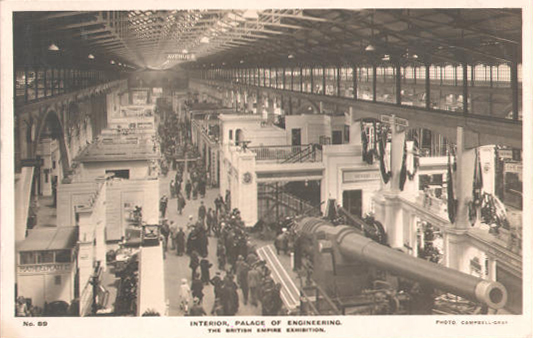
The Palace of Engineering, Wembley (1924). Proposed site of market relocation. Postcard, via Wikimedia Commons.
The dead meat market itself has operated under the recuring threat of relocation for over a century. Following the British Empire Exhibition in 1924–1925, there was a proposal to relocate Smithfield, Covent Garden, and Billingsgate to the site left behind at Wembley. Supporters argued that a move to the urban fringe would offer much needed space for food traders and the alleviation of traffic would benefit the city. Detractors argued that the market’s current location made it conveniently ‘get-at-able’ from North, South, East and West. In a somewhat overstated assessment of the city’s rapid growth, Smithfield’s superintendent noted that perhaps there wasn’t a clash between these ideas after all: ‘in all probability Wembley will be, say, in twenty years hence, the real centre of the Metropolis’. The first ‘three-in-one’ proposal, then, predated the Dagenham mega-market by nearly a hundred years, and the arguments made on both sides were strikingly familiar.
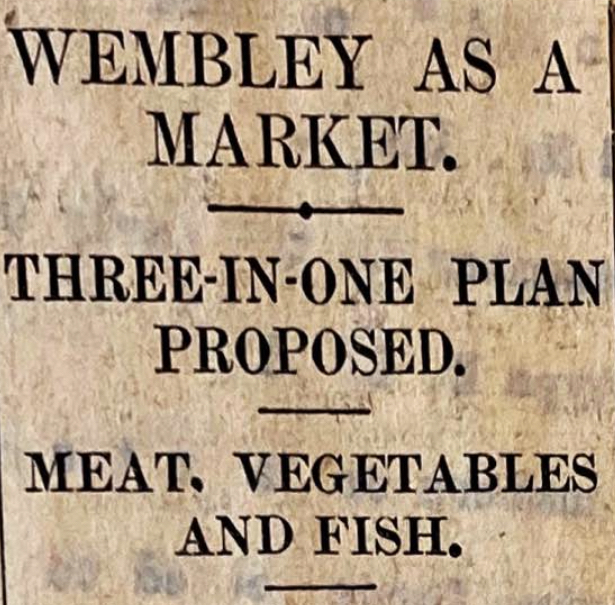
Newspaper clipping about the move. Courtesy of The London Archives.
Wembley of course became the home of football rather than home of wholesaling, but it was not long before Smithfield’s future once again looked bleak. During the Second World War, the market was mainly closed, with some areas remaining partially open as part of a larger network of geographically decentralised rationing depots under the control of the Ministry of Food. Through the 1940s, the market developed an increasingly bad reputation in the corridors of power for its propensity for industrial action. Once again proposals for relocating the market to ‘such places as Tottenham, Wilsden or Wembley’ were on the cards. In a private note to PM Clement Atlee in 1950, one minister was emphatic: ‘the present system gives far too much power to a small group of workers who are susceptible to communist intrigue and to actual intimidation ... as long as we have Smithfield we shall have trouble’.
From underground fires and closed shop unions to the rise of the National Front, trouble, indeed, was a common recurrence over the coming decades. Underwriting these headline-grabbing crises, however, was a much deeper trouble. As I outlined in my article, Smithfield entered a long and slow decline from the late 1960s, closely connected to both the decline of empire and the rise of supermarkets. By the 1980s, the market’s throughput was a quarter of what it had been at its peak. The Corporation adopted a ‘make do and mend’ approach: essentially running the market into the ground while plotting for the site’s potentially profitable re-development.
Yet, remarkably, unlike all of London’s other wholesale food markets, Smithfield remained in its historic location to welcome the new millennium. In 1988, the Corporation agreed to fund the market’s renovation, bringing it in line with European hygiene regulations and granting it another lease of life. The exact decision-making process here remains unclear. The site’s unwieldy nature—several listed buildings and a vast network of underground vaults—no doubt made it a daunting project for redevelopment. More importantly, however, was the sharp political manoeuvring of two influential traders at Smithfield, John Brewster and Peter Martinelli. The pair ‘infiltrated’ the City’s archaic political institutions, standing for office in the ward of Bassishaw and lobbying tirelessly for the market’s interests. As Brewster later recounted in an interview, ‘we found a flaw in the electoral system [and] infiltrated every committee conceivable ... they saw through us but it didn’t matter.’
And so Smithfield lived on in its central location for another few decades. Working to its own nocturnal rhythm, the market has seemed ever more at odds with the city changing rapidly around it. When the market moves—and it will be excellent if it does move rather than simply close—it will no doubt leave a more homogenous and less interesting city in its wake.
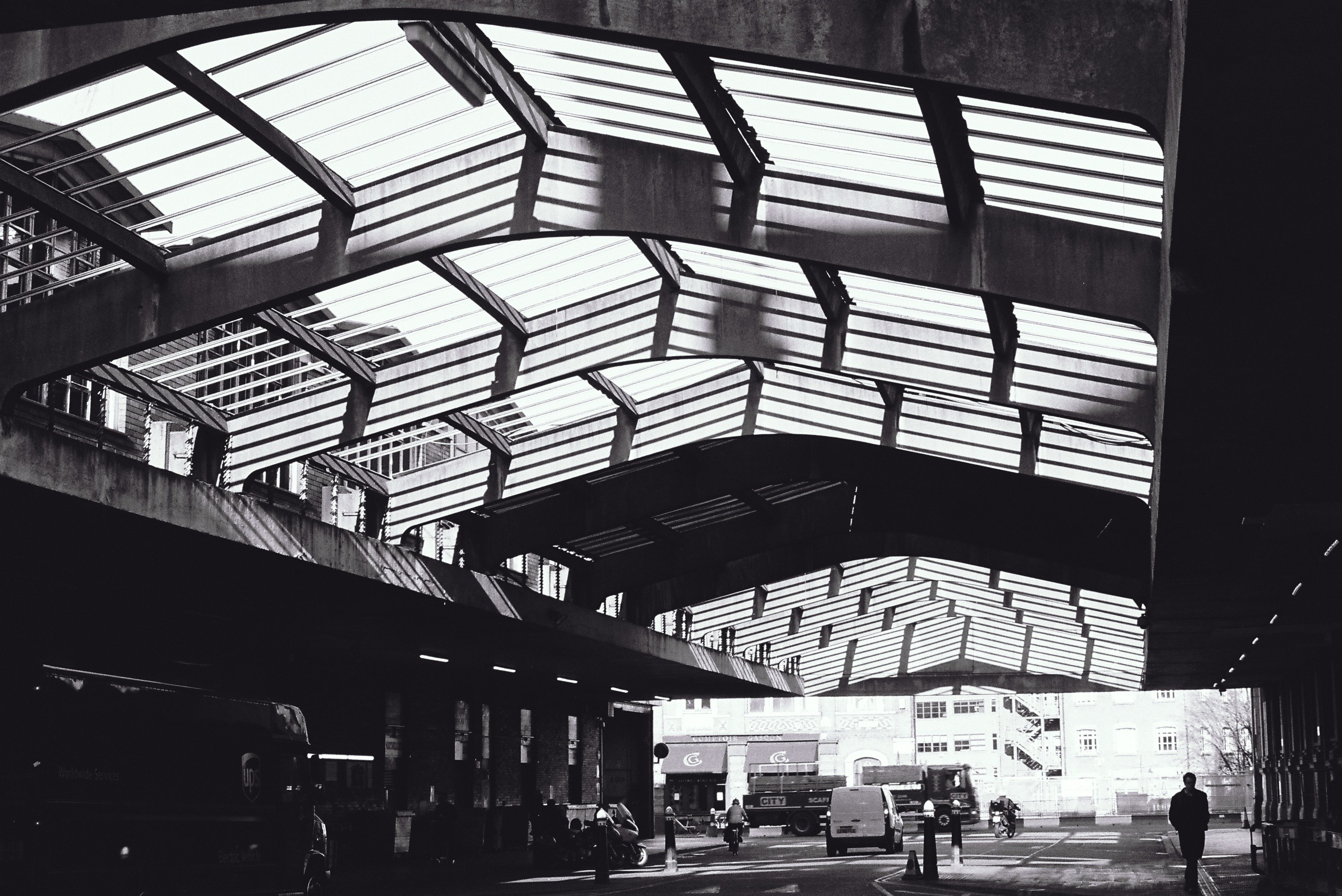
A pedestrian meanders along East Poultry Avenue, 2020. Photo by author.
But wholesale markets aren’t there for the gawping gaze of the flaneur or as living remnants of ‘tradition’. For many of the traders and workers, the current location simply doesn’t make sense and hasn’t for a long time (many of them commute from outside East London anyway). In interviews with traders during the last few years of tumult, there is a frequent frustration with the mismatch between press and public attention at moments of crises and complete disengagement the rest of the time. As one trader noted to the Radio 4’s The Food Programme last year, ‘everyone loves it but doesn’t come. Oww Smithfield this, Smithfield that. Well, when was the last time you went to Smithfield?’ While people are fascinated by Smithfield’s death, they seem less interested in its daily life.
Reflecting on Smithfield’s drawn-out survival in its present location, Justinien Tribillon’s excellent article on Paris’s Rungis market keeps coming to mind. As Tribillon explains, the incredible contemporary success of Rungis—Europe’s largest fresh food market—dates back to a phenomenally unpopular decision taken at the top of the French state in 1969 to close the beloved Les Halles market complex in central Paris and relocate its operations to the suburbs: ‘The belly of Paris would now be relocated to a state-of-the-art industrial estate at the end of a new motorway, far out in the suburbs ... before it could reach its current levels of efficiency and become one of the foremost fresh markets in the world, it had to sever its centuries-old ties to central Paris, slaughtering the historical core of the capital in the process’.
Parisians still mourn the loss of Les Halles. When the news of Smithfield’s closure was announced, I spoke to a journalist at Le Monde who explained how the French public were fascinated by Smithfield precisely because it represented what they lost in 1969 (it was not only the markets but also the buildings that were swept aside). But the success of Rungis is undeniable and few seriously question the wisdom of this unpopular decision. Today, Rungis supplies a remarkable 60% of the Paris region’s fresh food consumption. It is a symbol of quality in fresh produce across France and the rest of Europe. It is, in many ways, the model of how wholesale markets can facilitate the survival of small producers and seasonality in the context of global capitalist food systems.
London of course has had its own share of wholesale market relocations, with sites such as New Covent Garden and Spitalfields explicitly modelling their twenty-first century strategies on operations at Rungis. But relocation was never conducted at such a scale or with such conviction. Hence why, if Albert Island goes ahead, Billingsgate will have moved twice since 1980 and Smithfield’s 1990s renovation—which was meant to set it up ‘for a new millennium’—will have lasted less than 40 years. As food policy expert Tim Lang has long argued, the British state has taken a disastrously hands-off approach to food supply for centuries. The fact that the country’s primary wholesale markets have been administered not by the state but by the Corporation of London is indicative here. Edward III granted the Corporation the right to operate the city’s markets in 1327 and they have held the rights and responsibilities of London’s main public markets since. Beyond keeping them open, however, this legal apparatus has little effect on their operations or decision-making processes. The Corporation speaks two languages—money and tradition—and while they speak the latter fluently, it’s the former that makes them tick. In a sense, it’s hard to criticise their half-hearted policy on London’s wholesale food markets because there is simply no reason for them to have taken a more ambitious approach. The complex and intertwined relationship between public health, ecology, and agriculture that comes together in the food system is simply not on their agenda. Perhaps, then, it is not the Corporation’s ‘reckless disregard’ for history that we should be criticising here, but successive government’s reckless disregard for the food system.
When does the extension of life become slow death? Could a more decisive relocation of London’s wholesale market have put them in better stead to challenge supermarket dominance? We will never know. It remains to be seen what will happen at Smithfield and if the new purpose-built site at Albert Island might give London’s wholesale markets a new lease of life. The irony is that Smithfield’s remarkable survival in its central location is testament not to the importance of food in Britain but to its political irrelevance.
© The London Journal Trust .